What's Next for API Test Lab? 5 Features We're Prioritizing
From testing APIs to monitoring, automating, and improving them, here's what we're working toward.
I started API Test Lab to make API testing easier and more accessible. Checking an endpoint should help you understand your API without turning the setup itself into a project.
Today, the platform brings together API testing, load testing, traffic monitoring, uptime monitoring, and developer-focused analytics. Those capabilities answer useful questions: does this request work, how does it behave under load, and what is happening after deployment?
The next step is making those answers more connected throughout the API development lifecycle. A request you debug today should be easier to monitor tomorrow, reuse in a regression suite, and check before your next release.
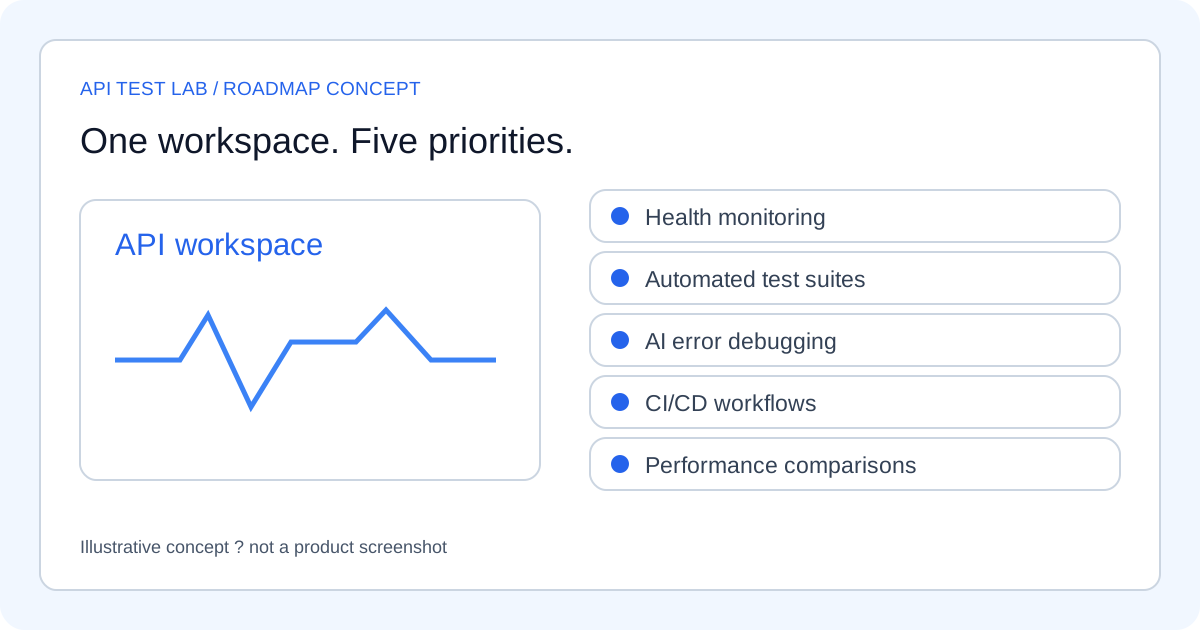
This API Test Lab roadmap describes five priorities. Some build on existing functionality; others are improvements we're exploring. These are product directions, with no promised release dates or guarantee that every idea will ship exactly as described. The illustrations below are concepts, not screenshots of available features.
1. Smarter API Health Monitoring & Alerts
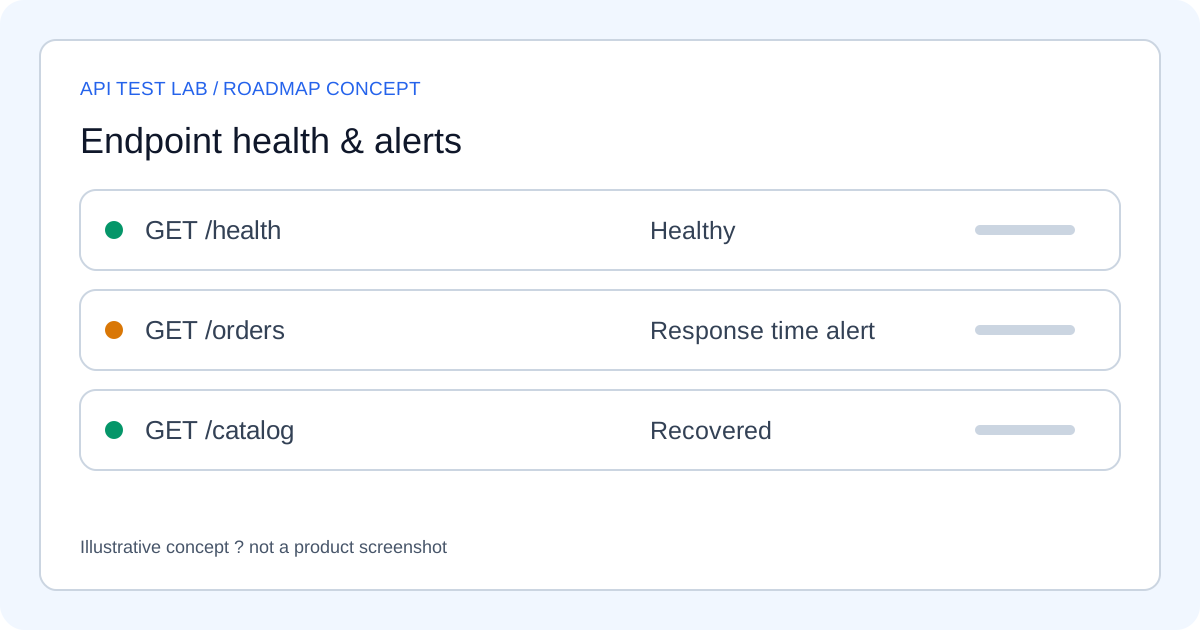
API Test Lab already has uptime monitoring, including scheduled endpoint checks, email alerts for downtime and recovery, and monitoring history. We're prioritizing a clearer monitoring experience around that foundation.
A successful manual test only tells you what happened at that moment. An endpoint can fail an hour later because a dependency times out, credentials expire, or a deployment changes its behavior. Developers need to hear about that failure without remembering to open a testing tab.
We want continuous endpoint monitoring to make HTTP failures and response time thresholds easier to understand together. An endpoint returning 200 can still be too slow for the application calling it. We're exploring clearer threshold configuration and alerts that explain whether a check failed, timed out, or exceeded an acceptable response time.
Email notifications should provide enough context to start investigating: which endpoint changed, what check failed, and when it happened. Recovery notifications and monitoring history should make it equally clear when service returns and how long an incident lasted.
Another priority is easy setup directly from an API request. Reusing a request's configuration could reduce repeated entry and help developers move from a successful test to ongoing checks. We'd also want the setup to make the monitored environment and credentials explicit.
2. Automated API Test Suites
Saved collections, response assertions, collection execution, and scheduled collection monitors already provide building blocks for automated API testing in API Test Lab. The priority is making those pieces feel like a coherent test suite workflow.
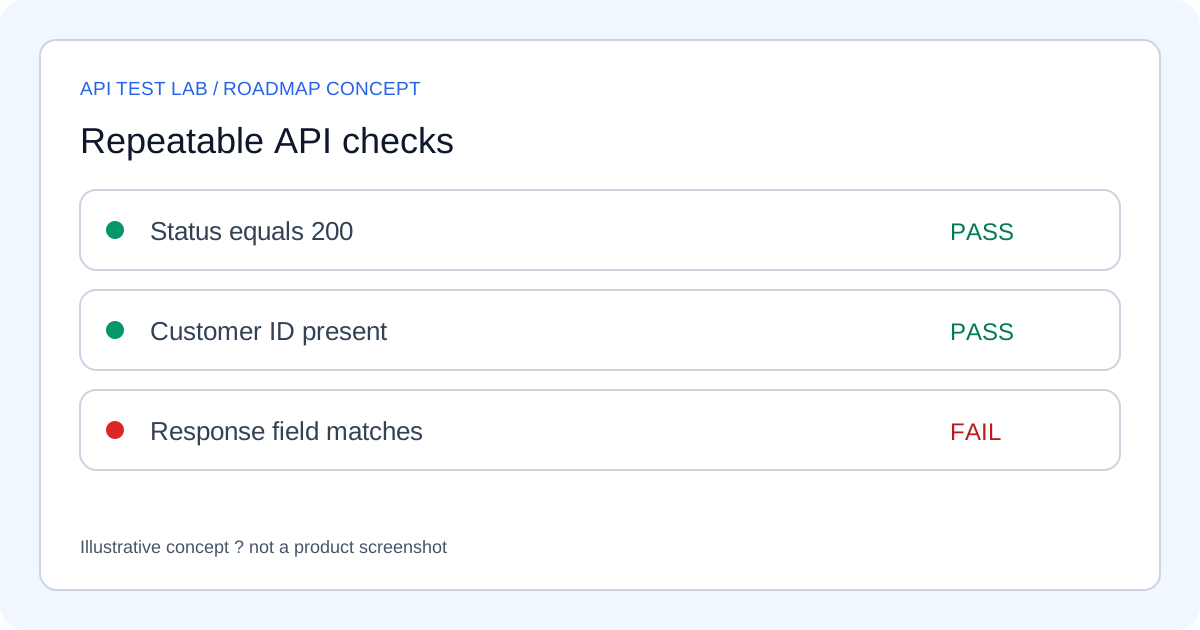
After a change, developers often repeat the same sequence: authenticate, fetch a resource, submit an update, then check the result. Manually repeating that sequence is slow, and skipping one request can hide a regression.
We want saving multiple API requests into test suites to feel straightforward, with status code and response assertions that describe the behavior you actually depend on. A 200 response is useful evidence, but it doesn't tell you whether the expected customer ID or required response field is present.
Scheduled test execution should fit naturally alongside manual runs. We're prioritizing clearer test run history and pass/fail reporting so a developer can see which assertion changed, inspect the failed response, and compare it with the last successful run.
Good automated regression testing also needs deliberate test data. A checkout suite should use an isolated environment and safe fixtures, rather than create real purchases whenever its schedule runs. Making that context visible is part of making automation practical.
Our API regression testing guide explains the kinds of checks worth preserving. This roadmap focuses on reducing the work required to maintain and repeat them.
3. AI-Powered API Error Debugging
API Test Lab already includes AI assistance for working with requests and responses. We're exploring more focused AI API debugging that helps developers turn a failed request into a useful next investigation step.
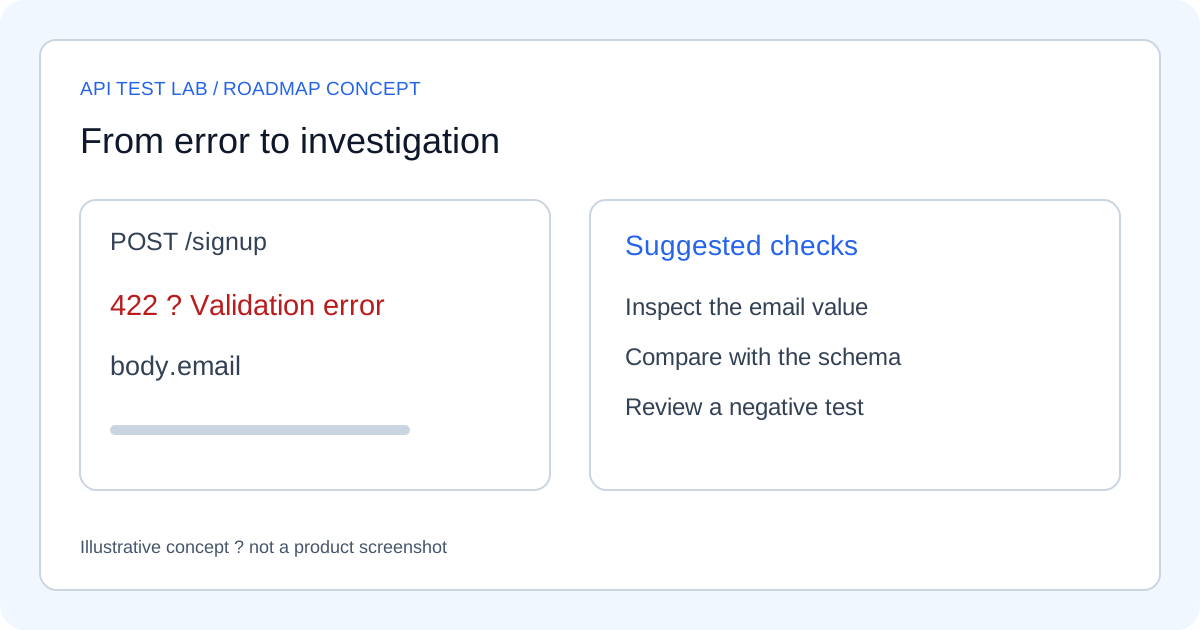
That means explaining HTTP errors, analyzing failed API responses, suggesting possible causes, and helping generate test assertions. Validation errors are a good example because the response often contains useful evidence that needs interpreting.
Imagine a signup endpoint returns HTTP 422 with this body:
{
  "detail": [
    {
      "loc": ["body", "email"],
      "msg": "value is not a valid email address",
      "type": "value_error.email"
    }
  ]
}
An assistant could explain that this response points to the email field in the request body. It could suggest checking the submitted value for a missing domain or accidental whitespace, comparing it with the documented schema, and retrying with a known valid test address.
It could also suggest a negative test: submit an invalid address and assert that the endpoint returns 422 with a validation detail identifying email. That turns a debugging session into a reusable check. The developer should review the assertion against the API's intended contract before saving it.
These are suggestions, not a guaranteed diagnosis. An assistant cannot infer every server-side rule from a response. Actual debugging still requires reproducing the issue, checking application logs, and examining the implementation.
Sensitive headers, authorization tokens, cookies, credentials, and confidential payload fields must be protected before any data is sent to an AI service. We're prioritizing controls that make the shared context clear and support sending only the minimum sanitized evidence needed.
4. GitHub Actions & CI/CD Integration
API Test Lab already exposes automation interfaces and self-serve API keys documented for CI/CD use. We're prioritizing a smoother GitHub Actions and CI/CD integration experience on top of that existing access.
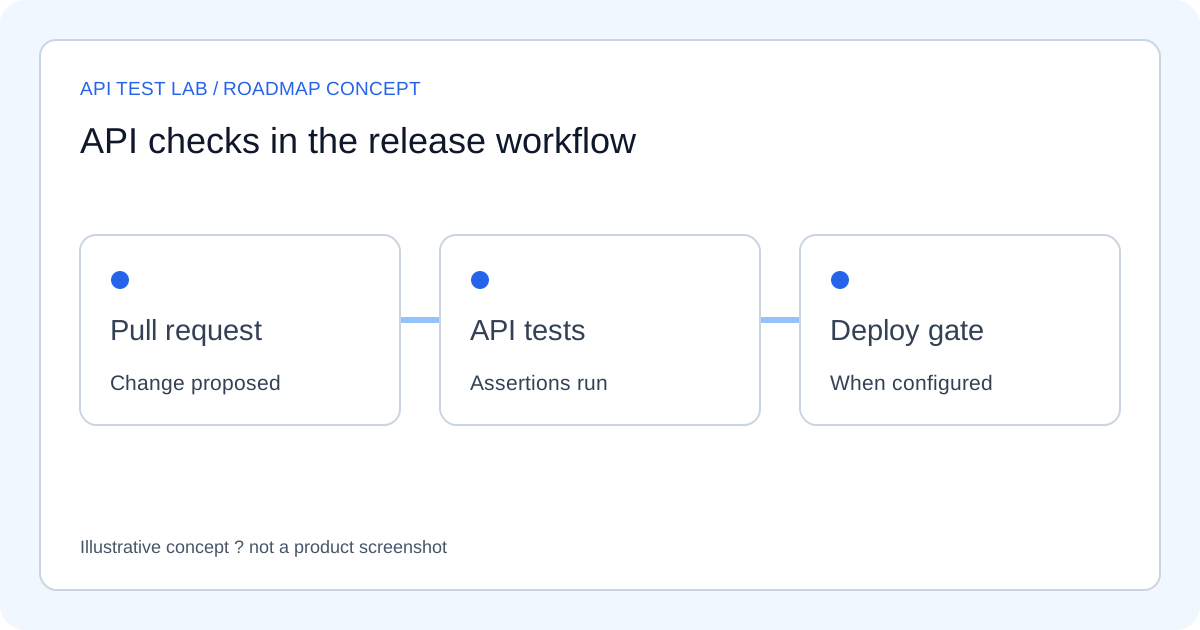
API testing should become part of shipping software. If a developer has to remember to open another tool after every pull request, useful checks will eventually be missed.
We're exploring a clearer path for running API tests on pull requests and performing automated checks before deployment. Test results inside CI pipelines should identify the failed request and assertion without requiring developers to search through a wall of output.
CLI-based test execution is another priority: select the intended suite and environment, execute it from a runner, and return a useful result to the surrounding workflow. We aren't announcing a new supported CLI command in this article; the goal is a developer-friendly execution path that works with established build tooling.
When configured, failed assertions should block deployment through the pipeline's failure handling and required checks. Teams should decide which suites are release gates and which are informational. Credentials belong in the CI secret store, and pull requests from untrusted forks need an explicit policy for secret access.
The existing documentation remains the place to check currently supported automation interfaces. Roadmap examples shouldn't be mistaken for an integration that is already available.
5. API Performance Regression Detection
Load testing and latency analytics already help developers inspect API performance. We're prioritizing more useful historical comparisons, so answering "is this slower than before?" takes less manual work.
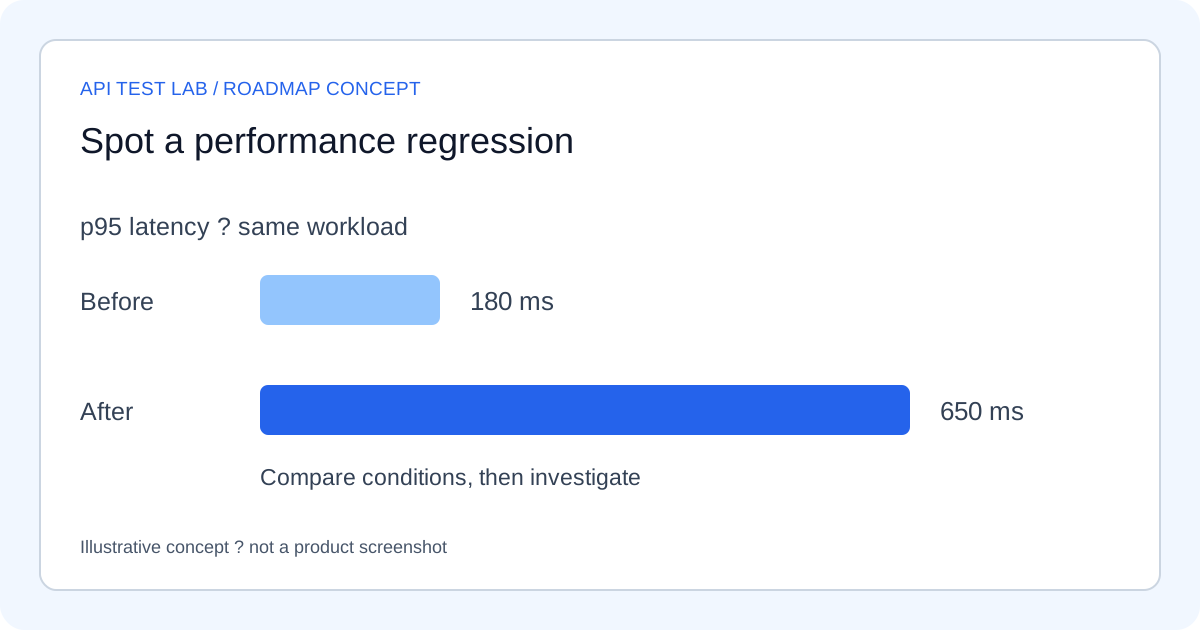
Consider an endpoint whose p95 latency increases from 180 ms to 650 ms after a release. In this illustrative example, most requests might still return successfully, and an average alone could make the change look less serious. The slower tail deserves investigation.
We want to make tracking average and p95 response times, comparing previous and current test runs, and visualizing latency changes easier in one place. Monitoring error rates alongside timings matters too: a test that returns errors quickly can appear faster while serving fewer successful requests.
Historical comparisons can help identify potentially slow endpoints and narrow the investigation toward a changed query, an extra downstream call, or a different caching pattern. They don't prove the cause. Developers still need traces, logs, and application context to confirm it.
Useful performance regression detection also depends on comparable tests. Request volume, concurrency, region, payloads, dataset, and environment should be similar before treating a difference as a release regression. Sample sizes and measurement windows need to remain visible. Our p50, p95, and p99 guide explains how to interpret those metrics.
One Platform. Fewer Tools. Better APIs.
The long-term vision is one developer-friendly workspace for API testing, load testing, monitoring, automation, and debugging. Each capability becomes more useful when the context carries forward: a saved request becomes a check, a failed check becomes an investigation, and the fix becomes a regression test.
I want API Test Lab to reduce repeated setup and context switching while keeping the underlying evidence accessible. Developers should be able to inspect a response, understand an assertion, and decide whether a performance change matters.
API Test Lab has a free tier for getting started. The pricing page has current plan details; this roadmap doesn't announce changes to pricing or access limits.
Help Shape the Future of API Test Lab
These priorities come back to a practical goal: help developers understand their APIs and carry that understanding from development through production.
Which would help you most: clearer monitoring alerts, reusable test suites, focused debugging assistance, smoother CI integration, or performance comparisons? Tell us what you do today and where the workflow gets frustrating. A concrete example helps us prioritize better than a feature name alone.
Share your feedback through our existing contact page. I'd like to hear which feature you want most and what problem you need it to solve.
More from the blog
Read 3 related articles from our latest posts.